- Harley St, Port Harcourt, 500101, Rivers
- +234 0815 149 1555
- info@rsuth.ng

College of Community Health Officer (CHO)
- Home
- College of Community Health Officer (CHO)
College of Community Health Officer, Rivers State University Teaching Hospital.
About Us
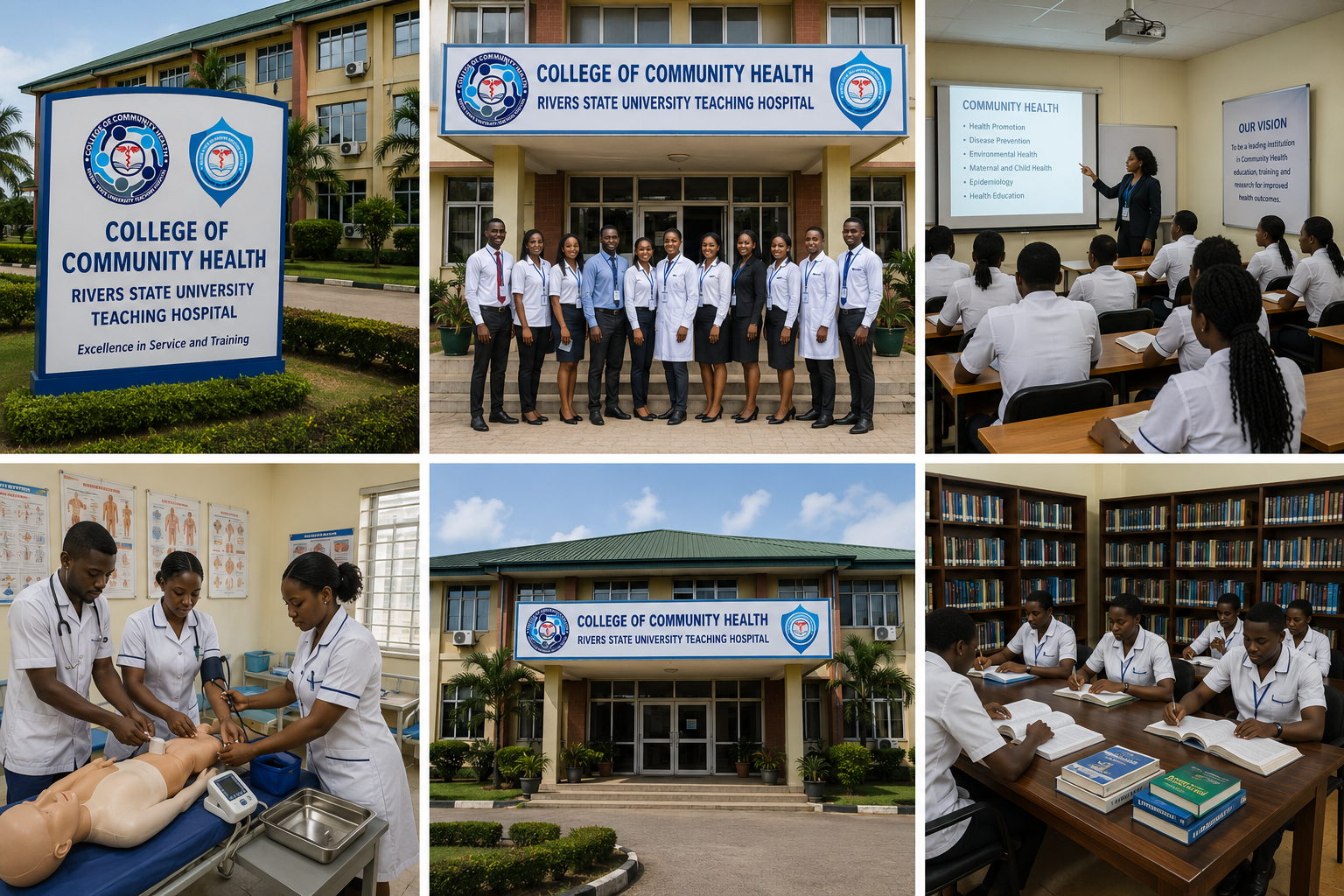
The College of Community Health Officer, Rivers State University Teaching Hospital (RSUTH) was established to promote excellence in community health education, training, and research by developing competent and compassionate Community Health Practitioners equipped to meet the healthcare needs of individuals, families, and communities. Through a comprehensive competency-based curriculum, the College combines quality classroom instruction with practical clinical and community-based training to equip students with the knowledge, skills, and professional ethics required for effective primary healthcare delivery, disease prevention, health promotion, and community development. Supported by experienced faculty, modern learning facilities, and the clinical resources of Rivers State University Teaching Hospital, the College is committed to producing highly skilled healthcare professionals who are prepared to contribute meaningfully to improving health outcomes and strengthening healthcare systems at the local, national, and global levels.
Vision
To be a leading institution for community health education, producing highly skilled, competent, and ethical Community Health Practitioners who deliver quality primary healthcare, promote healthy communities, and contribute to improving health outcomes through excellence in education, research, and service.
Mission
To provide quality community health education through competency-based training, practical clinical experience, research, and community engagement, equipping students with the knowledge, skills, and professional values required to deliver accessible, preventive, promotive, and curative healthcare services while meeting the evolving healthcare needs of society.
Course Modules
- Responsibility of Care
- Role Comprehension
- Residents’ Rights, Privacy and Dignity
- Equality and Diversity
- Basic Communication Skills
- Nutrition and Hydration
- Vital Signs and Monitoring
- Medication Management and Safety
- First Aid
- Basic Life Support
- Safeguarding Adult
- End of Life Care
- Infection Prevention and Control
- Specialized Care: Dementia, Post Stroke, Mental Health
- Assisting with Activities of Daily Living
- Risk Management, Fall Prevention, and Ambulation
- Digital Skills for Healthcare Assistants and Caregivers
Who Should Attend
This programme is designed for individuals who are passionate about community health and primary healthcare delivery, including secondary school graduates with the required O’Level credits, aspiring Community Health Extension Workers (CHEWs), healthcare assistants, health volunteers, and individuals seeking a rewarding career in community health. It is also suitable for healthcare professionals who wish to strengthen their knowledge and practical skills in disease prevention, health promotion, maternal and child health, environmental health, and community-based healthcare services.
Eligibility Criteria
To be admitted into CHO programme, applicants must possess the following requirements or equivalent:
At least 5 O’Level credits in:
- Physics
- Chemistry
- Biology
- Mathematics
- English
- Relevant professional qualifications (like CHEW or degrees in health sciences)
- Active clinical experience
- A valid license from the Community Health Practitioners’ Registration Board of Nigeria (CHPRBN).
N/B: The specific admission criteria differ based on whether you are applying for the one-year or two-year programme:
📌 NOTE:
- The courses are offered onsite (Physical).
-
-
1-Year Programme (Conversion/Accelerated)
This is for candidates with existing foundational training who want to upgrade to a Higher Diploma.
- Qualifications: Diploma in Community Health Extension Worker (CHEW) OR a first degree in Community Health, Public Health, Health Education, or other related health sciences.
- Experience: At least 2 years of post-qualification experience in a clinical/health area.
- Additional: National Youth Service Corps (NYSC) Discharge/Exemption Certificate for university degree holders.
-
-
-
2-Year Programme
This is a standard Higher Diploma track for experienced community health extension workers.
- Qualifications: Diploma in Community Health / Community Health Extension Worker (CHEW) certificate.
- Experience: Typically requires about 2 to 5 years of post-qualification work experience in a recognised health facility
-
⏱️ COMMENCEMENT OF ACADEMIC SESSION
First Semester (12 Weeks)
- Orientation: 1st week of September 2026
- Lectures commence: 2nd week of September 2026
- Lecture Schedule: 9:00 a.m. – 4:00 p.m. daily
- Examination begins: 2nd week of December 2026
- Vacation starts: 3rd week of December 2026
Second Semester (12 Weeks)
- Starts: 2nd week of January 2027
- Lecture Schedule: 9:00 a.m. – 4:00 p.m. daily
- Allocation of research topics & supervisors
- Examination begins: 2nd week of April 2027
- Vacation starts: 3rd week of April 2027
Third Semester (12 Weeks)
-
- Starts: 3rd week of May 2027
- Lecture Schedule: 9:00 a.m. – 4:00 p.m. daily
- Commencement of research work
- Examination begins: 3rd week of July 2027
- Vacation starts: 4th week of July 2027
🕒 LECTURE TIMING (COHORTS)
Fourth Semester (12 Weeks)
- Starts: 1st week of September 2027
- Lecture Schedule: 9:00 a.m. – 4:00 p.m. daily
- Clinic rotations
- Examination begins: 1st week of December 2027
- Project work defense
- Conclusion of programme: 3rd week of December 2027
Notes from the document:
- The form fee has been manually revised from ₦30,000 to ₦25,000 in red ink.
- There are handwritten annotations near the advert dates that are not fully legible from the image.
Methodology
CHO uses a structured, hands-on learning model:
MONTH 1
- Orientation on use of tech platforms and tools
- Introduction to the CHO learning model
- Pre-test assessments
- Faculty-led teaching (2 hours daily)
MONTH 2
- Interactive training modules distributed
- Skill acquisition via simulations, drills, lab tours
- Individual and group assignments
MONTH 3
- Final report writing
- Capstone project presentation
- Final examination
Outcome and Certification
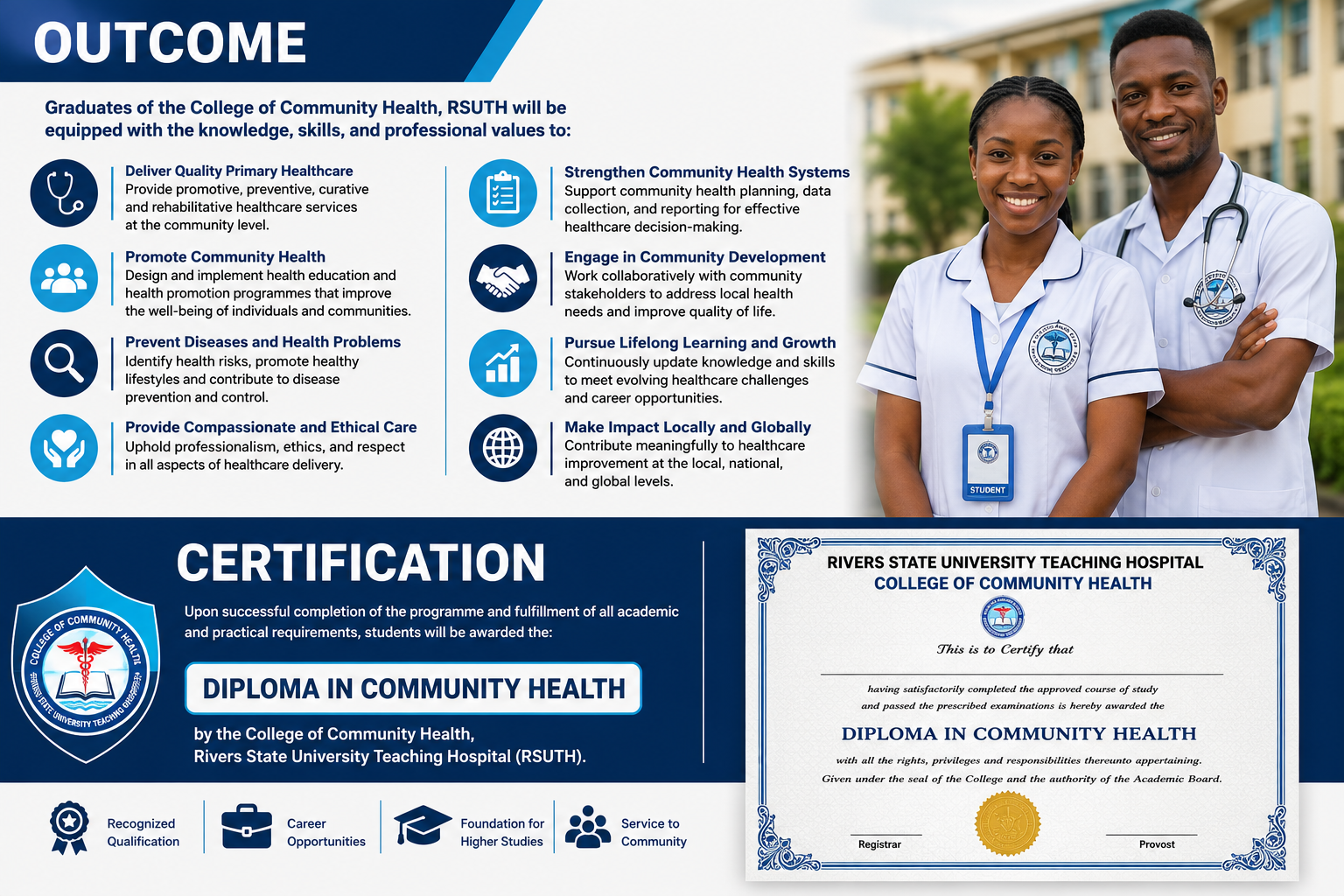
Upon successful completion of each course, students will receive a Certificate of Achievement, based on:
- Participation in assignments and simulations
- Completion of capstone project
- Final examination performance

📝 HOW TO APPLY
Follow these steps to begin your journey at CHO:
- On the CHO website, scroll down to Course Modules
- Click on Apply
- On RSUTH Applications Portal, click on Applications
- Complete the CHO Admission Form. Fill in all required details and select “College of Community Health” as your institute.
- Click on Make Payment and Pay the Application Fee (₦25,000). Payment can be made securely online using debit card or bank transfer.
APPLICATION FEE IS NON-REFUNDABLE. - To complete your admission process, visit the CHO Office with your CHO Application Slip and pay the course fee.
📢 ADMISSION TIMELINE
- Application Opens: July 13, 2026
- Deadline for Applications: August 2, 2026
- Session Begins: September, 2026
CONTACT INFORMATION
College of Community Health Officer, Room 202, Main Block, Rivers State University Teaching Hospital, Port Harcourt, Rivers State, Nigeria.
 PHONE: 07068300655; 08066992304
 EMAIL: cenhact@rsuth.ng
 WEBSITE: https://www.rsuth.ng/cenhact/
Meet Our Faculties
Our programmes are designed for a broad range of professionals and aspiring experts seeking to build capacity or transition into the infectious disease and public health research space.

Prof. Chizindu A. Alikor
MBBS, MMED, Ph.D, FWACP, FCNPSA, FNCS, FIAEA
Professor of Cardiovascular Medicine, Rivers State University
Chief Medical Director, Rivers State University Teaching Hospital
Email: alikor.chizindu@rsuth.ng

Dr. Elageche Wesley Okachi
MBBS, FMCP.
Director, Center for Healthcare Assistant and Caregiver Training (CENHACT)
Consultant Nephrologist and Physician; Lecturer I, Department of Internal Medicine, Rivers State University
Honorary Consultant Rivers State University Teaching Hospital
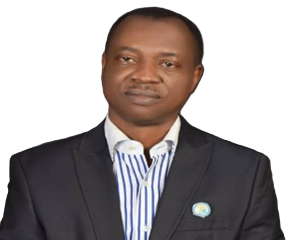
Eze (Dr) Golden Owhonda
MBBS, FWACP (Nig), FRSPH (UK)
Associate Professor of Public Medicine, Rivers State University.
Honorary Consultant, Rivers State University Teaching Hospital
- Email: golden.owhonda@ust.edu.ng